Wind vs. Flood vs. Homeowners: Which Claim Pays After a Texas Hurricane
If you own a home on the Texas coast, flood insurance in Corpus Christi is not a bolt-on to your homeowners policy — it is one of three separate contracts that decide who pays after a hurricane. After a named storm three policies can be in play: your homeowners policy, a windstorm policy (often through the Texas Windstorm Insurance Association), and a flood policy through the National Flood Insurance Program or a private flood market. Each pays for a different cause of damage, and the water that ruined your floors does not care which paperwork you filed. Below: how the three divide the work, where the gaps open, and what to verify on your own declarations pages this week.
The three policies, in one pass
The Texas Department of Insurance frames it plainly on its consumer pages: a homeowners policy protects your house and belongings, a flood policy covers damage from rising water, and a windstorm policy covers wind and hail.
- Homeowners — the broad policy. Fire, lightning, theft, and (inland) wind and hail. It is the policy people think of as “my insurance.”
- Windstorm — wind and hail damage. In the designated coastal counties, insurers frequently exclude wind and hail, and coverage is bought separately, often from TWIA.
- Flood — damage from rising water, storm surge, and overflow. Never part of a homeowners policy. It is bought as its own policy.
What a TWIA policy actually covers
TWIA states it directly: TWIA policies provide coverage only for windstorm and hail damage to property covered by the policy, and by law no other perils — such as fire or theft — are covered.
The TWIA dwelling policy excludes loss caused by or resulting from flood, surface water, waves, storm surge, tides, tidal water, tsunami, overflow of streams or other bodies of water, or spray from any of these — whether driven by wind or not.
What flood insurance covers, and the deadline nobody plans for
Flood coverage in most Texas coastal households comes from the NFIP. FEMA’s program offers up to $250,000 of building coverage and up to $100,000 of contents coverage for a residential building. For business owners, the program offers up to $500,000 building and $500,000 contents.
FEMA’s guidance is that NFIP coverage generally goes into effect 30 days after the date of purchase, with a short list of exceptions — notably a purchase made in connection with a loan closing, a property newly designated as high-risk within a set window after a map change, and the post-wildfire exception.
The flood requirement hiding inside your windstorm eligibility
TWIA says it strongly recommends flood insurance for all policyholders, and requires it when certain conditions are met: properties located in flood zones V, VE, or V1-30 that were constructed, altered, remodeled, or enlarged on or after September 1, 2009, and that can obtain flood insurance through the NFIP, must provide proof of flood coverage.
Certificates of compliance: the WPI-8 problem
For TWIA eligibility, Texas law requires that structures built, altered, or repaired on or after the applicable dates be certified as meeting windstorm building code requirements. The certificate comes as a WPI-8 or WPI-8-E from the Texas Department of Insurance, or a WPI-8-C from TWIA, and it applies to ongoing improvements including alterations, remodeling, enlargement, additions, and repairs, including reroofing.
Reroofing is the trap. A roof replaced after a hail event, without an inspection and certificate, can create an eligibility problem that nobody notices until the next application or the next claim. If a contractor replaced your roof and you never saw a certificate number, treat that as an open item.
Deductibles: where two policies quietly become two bills
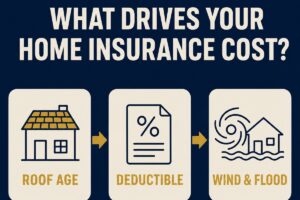
TDI explains that a percentage deductible is calculated as a percentage of the amount your home is insured for, not a percentage of the claim — which is why a small hail claim can fall entirely inside the deductible on a percentage policy. Coastal households commonly carry different structures on different policies, and the terms are not interchangeable: a wind/hail deductible applies broadly, while named-storm and hurricane deductibles are triggered only by storms meeting the policy’s definition.
How a real coastal claim splits up
Picture a Corpus Christi home after landfall. Shingles gone and rain through the ceiling: that starts with wind, so it goes to the windstorm carrier. Water that rose from the street or the bay and soaked the bottom two feet of drywall: that is flood, so it goes to the flood policy.
Check this on your own policies this week
Pull your declarations pages — homeowners, windstorm, and flood if you have one — and work down this list. If you cannot answer an item from the documents in front of you, that is a finding, not a failure.
- Do you have a separate windstorm policy at all? Look for a wind/hail exclusion on the homeowners declarations and a matching windstorm or TWIA policy number.
- Do you have a flood policy? Not “am I in a flood zone” — is there a flood policy number and an effective date?
- If you have flood coverage, does it include contents? Confirm both building and contents limits appear.
- Write down all three deductibles. Note whether each is a flat dollar amount or a percentage, and whether it says wind/hail, named storm, or hurricane.
- Is your dwelling limit anywhere near current rebuild cost? Coastal labor and materials pricing moves; a limit set years ago rarely tracks it.
- Do you know your WPI-8 status? If a roof or addition was done since you bought the house, find the certificate number or confirm one exists.
- Did any renovation happen on or after September 1, 2009 while the property sits in a V, VE, or V1-30 zone? If so, check whether proof of flood coverage is required for your windstorm eligibility.
- Are your mailing address, mortgagee, and phone number current on all three policies? Claim payments and inspection calls go to whatever is on file.
- Do you have a contents inventory and exterior photos dated within the last year? If not, that is a 30-minute walk-around with your phone.
- Do you know each carrier’s claim phone number without logging in? Save all three in your phone under the same keyword.
Small employers on the coast have the same seam
The wind/flood/property split is not only a household issue. A commercial building, its contents, and the income lost while it is closed are covered under different forms with different triggers, and the NFIP’s commercial limits are their own ceiling. If you own a building or lease space in Corpus Christi, the same three questions apply — who pays for wind, who pays for water, and what happens to payroll while the doors are shut. See our business insurance, general liability, and employee benefits pages.
Get a second set of eyes before the next named storm
As an independent agency in Corpus Christi, we are not defending one carrier’s paperwork — we read all three policies side by side and tell you where the seams are. That is the whole point of the free coverage review: you send the declarations pages, we map wind, flood, and homeowners against your actual property, and you get a plain-language list of what is covered, what is not, and what you may want to change while the market is calm. If windstorm is your main worry, start with the TWIA coverage review.
Next reads: flood insurance, windstorm insurance in Corpus Christi, home insurance in Corpus Christi, renters insurance, and claims help if you are already in the middle of one.
This article is general information for Texas coastal property owners and is not a coverage opinion on any specific policy. Whether a particular loss is covered depends on your property, your policy forms, endorsements, and your policy terms — read your own declarations pages and policy language, and talk with a licensed agent before making a decision. Sources: Texas Windstorm Insurance Association (twia.org — Inside a Policy, Coverage & Eligibility, Flood Insurance Requirements, Windstorm Certification, TWIA Dwelling Policy), Texas Department of Insurance (tdi.texas.gov — “Home, flood, wind: Which policies do you need?”, flood insurance, windstorm inspections, deductibles), and FEMA’s National Flood Insurance Program (floodsmart.gov — Buy a Policy, Types of Coverage).
Not sure if you're overpaying?
It takes us less than five minutes to compare your current policy against 15+ Texas carriers.
Get a Free Quote