Contractors Insurance in Texas: The Coverages GCs Actually Ask You For
Contractors insurance in Texas is rarely bought because a contractor woke up wanting it. It gets bought because a general contractor, a property owner, or a city sent over an insurance requirements page and said the crew cannot start until the certificate matches. If you are a Corpus Christi roofer, remodeler, electrician, or sub who works up and down the coast, the fastest way to lose a job is to hand over a certificate that is missing one line the GC’s contract required.
What “contractors insurance” really means in Texas
There is no single policy called contractors insurance. It is a package: usually a general liability policy at the center, plus whatever the job, the vehicles, the crew, and the contract require around it. What you are legally obligated to carry and what you are contractually obligated to carry are two very different lists. The contract list is almost always longer.
General liability: the coverage on every certificate
Commercial general liability responds to third-party bodily injury and property damage claims arising out of your operations. “Third party” means someone who is not your employee; injuries to your own workers are a different system entirely.
What varies between contractors is not whether they have general liability but what has been carved out of it. Common contract sticking points include per-occurrence versus aggregate limits, whether the aggregate applies per project, exclusions tied to specific trades or heights, subcontractor warranty conditions, and whether the GC has to be added as an additional insured with a waiver of subrogation. Those endorsements are not automatic. They have to be on the policy before the certificate can say so.
Workers’ compensation is optional in Texas – and that is why it is complicated
Texas is the outlier: private employers here generally may choose not to carry workers’ compensation insurance. But opting out is not silent. TDI’s Division of Workers’ Compensation requires an employer without coverage to file DWC Form-005, Employer Notice of No Coverage or Termination of Coverage, and non-subscribers must file that notice annually between February 1 and April 30. Non-covered employers also have to report work-related injuries involving more than one day of lost time, plus occupational illnesses and deaths, and must notify employees that there is no coverage.
Two more rules matter enormously on construction jobs:
- Public projects. Under Texas Labor Code §406.096, a governmental entity that enters into a building or construction contract must require the contractor to certify in writing that it provides workers’ compensation coverage for each employee on that public project. Rule 28 TAC §110.110 also requires a notice posted on the project site telling everyone providing services that coverage is required. If you bid municipal, school, or state work, “we’re a non-subscriber” is not an option on that job.
- Subs and statutory employment. Labor Code §§406.121-406.123 govern when a subcontractor and the sub’s employees are treated as employees of the general contractor. A written agreement can establish an independent relationship, and §406.123 lets a GC agree in writing to provide coverage to a sub and the sub’s employees. The paperwork – not the handshake – decides who is on the hook.
Deciding between subscribing and going non-subscriber is a contractual and legal question as much as an insurance one. Start with workers’ compensation and the actual contracts you sign.
Commercial auto – including trucks you do not own
Vehicles used for business generally belong on a commercial auto policy, not a personal one. Texas financial responsibility minimums are 30/60/25 – $30,000 per injured person, $60,000 per accident for bodily injury, and $25,000 for property damage – and construction contracts routinely require far higher limits than the state floor.
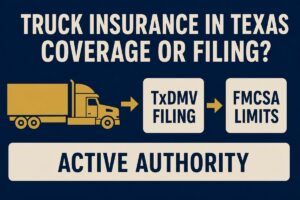
The gap that catches small crews: employees running to the supply house in their own trucks, or a rented lift truck for a week. Hired and non-owned auto coverage is the endorsement that addresses those, and it is often missing from the certificate a GC just rejected. Review your fleet list and your driver list together on your commercial auto policy.
The certificate of insurance is a snapshot, not a policy
Certificates of insurance are regulated in Texas under Insurance Code Chapter 1811 and 28 TAC §§5.9370-5.9376. Two points every contractor should know:
- A certificate cannot say anything different from what the policy says (Insurance Code §1811.051). It does not amend, extend, or alter coverage, and it does not create contractual rights for the certificate holder.
- Certificate of insurance forms have to be filed with and approved by TDI (§1811.052), and an approved form may not be altered or modified without TDI approval (28 TAC §5.9376).
So when a GC asks you to have your agent “just add that to the certificate,” the honest answer is that the coverage has to exist on the policy first. Getting the endorsement issued is the real work; the certificate only reports it.
Coastal jobs: windstorm certification and the exposures that come with the salt air
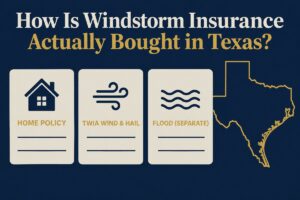
Anyone building or repairing in the Texas catastrophe area has a second compliance track. TDI issues Certificates of Compliance (WPI-8 and WPI-8-E) after inspection of construction, and TWIA requires a certificate for a structure to be eligible for wind and hail coverage. TWIA’s materials list WPI-8, WPI-8-E, and the older TWIA-issued WPI-8-C as the accepted forms.
If your work touches the coast, read our page on windstorm insurance in Corpus Christi so you can answer the question your customers will ask.
What contracts add beyond the basics
Depending on the trade and the project, requirement pages also call for tools and equipment coverage, builder’s risk or installation coverage on the work in progress, an excess or umbrella layer sitting above general liability and auto, professional liability for design-build or specification work, cyber liability where you handle customer payment data, and employment practices liability once the crew grows. Some contractor risks are placed with surplus lines carriers; TDI’s consumer guidance is worth knowing here – surplus lines insurers are not members of the Texas property and casualty guaranty association, so a carrier insolvency is not backstopped the way it is with an admitted company.
Check this on your own policy before the next bid
- Pull your general liability declarations and write down the per-occurrence limit, the general aggregate, and whether the aggregate applies per project.
- Find the additional insured and waiver of subrogation endorsements. Are they blanket (automatic when a contract requires it) or scheduled to specific named parties?
- Check whether your policy has a subcontractor warranty – a condition requiring signed agreements and certificates from every sub you use.
- List every vehicle and every driver, then confirm hired and non-owned auto is on the policy if anyone drives their own truck for work.
- Confirm your workers’ compensation status in writing. If you are a non-subscriber, is the DWC Form-005 filing current for this year, and are employees notified?
- For public work, locate the written coverage certification and the project-site posting the rules require.
- Look for exclusions attached to your specific trade – roofing, heights, hot work, excavation, EIFS, residential work.
- Compare the limits and endorsements on your policy against the insurance requirements page of the contract you are about to sign, line by line.
- Note your policy expiration dates and whether any GC requires advance notice of cancellation.
Get a second set of eyes before you sign
BenefitExcel is an independent agency in Corpus Christi, which means we compare your program across markets rather than defending one carrier’s form. We will read your contract’s insurance requirements alongside your current declarations and tell you plainly where they do not line up. See our business insurance page for the full picture, or book a free coverage review and bring the requirements page from your next job.
Crews are the other half of the program. If you are weighing coverage for your employees, see what to ask about group health insurance in Corpus Christi.
This article is general information for Texas contractors and business owners, not a coverage opinion on any specific policy, contract, or project. What is covered depends on your operations, your policy terms, and the contracts you sign. Sources: Texas Department of Insurance (tdi.texas.gov) – commercial insurance, workers’ compensation non-subscriber requirements and DWC Form-005, certificates of insurance under Insurance Code Chapter 1811 and 28 TAC 5.9370-5.9376, windstorm inspection program and adopted codes, surplus lines consumer guide; Texas Labor Code 406.096 and 406.121-406.123; Texas Windstorm Insurance Association (twia.org).
Not sure if you're overpaying?
It takes us less than five minutes to compare your current policy against 15+ Texas carriers.
Get a Free Quote