Commercial Insurance in Corpus Christi: What a Business Owner Should Actually Compare
Shopping for commercial insurance in Corpus Christi is not really a shopping problem — it is a comparison problem. Two proposals for the same building, the same payroll and the same delivery van can land within a few dollars of each other and still cover your business very differently once a storm comes off the Gulf.
Here is what a coastal Texas business owner should compare, line by line, before signing anything.
Start with what the business actually owns and owes
Before you compare anything, write down what has to be protected. The Texas Department of Insurance groups business coverage into a handful of buckets, and most small commercial programs are assembled from the same pieces:
- Property — the building if you own it, plus your business personal property (equipment, inventory, furniture, tenant improvements) if you lease.
- Liability — claims for bodily injury or property damage to other people, usually on a general liability form.
- Vehicles — anything titled to the business, or personal vehicles used for work, on a commercial auto policy.
- People — workers’ compensation, and employee benefits in Corpus Christi if you offer them.
- Specialty exposures — cyber, professional liability, employment practices, and an umbrella over the whole stack.
TDI notes that a property owner’s policy protects the building and associated structures but will not protect a tenant’s property, and that business owners who lease space commonly buy coverage for the contents instead.
Compare the form, not just the premium
Many small businesses are written on a package — a businessowners policy or a commercial package policy — that bundles property and liability, and sometimes inland marine and auto, into one contract. TDI’s own consumer material points out that buying coverages packaged together is usually cheaper than buying each one separately, but the packaging also hides the differences.
Two proposals can both say “property and liability” while sitting on entirely different forms. Ask each agent, in writing, which form numbers and endorsements are being quoted.
On the coast, the wind and flood answer decides everything
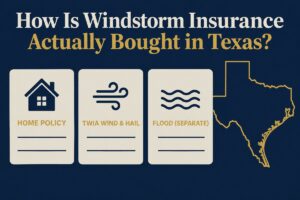
Nueces County is one of the 14 first-tier coastal counties in TWIA’s designated catastrophe area (along with Aransas, Brazoria, Calhoun, Cameron, Chambers, Galveston, Jefferson, Kenedy, Kleberg, Matagorda, Refugio, San Patricio and Willacy), plus parts of Harris County east of Highway 146 inside the city limits. That matters because many coastal commercial property policies exclude windstorm and hail, and the wind coverage is bought separately.
The Texas Windstorm Insurance Association writes commercial risks as well as homes, and eligibility is conditional: TWIA requires a declination from an authorized insurer, and its submission guidelines also reference flood insurance and building code requirements. Its rating rules manual lists percentage windstorm deductibles — 1%, 2% or 5% per item, per occurrence — as mandatory on items rated from certain commercial tables.
Flood is separate again. Commercial property policies exclude flood and storm surge; that risk is insured through the NFIP or a private flood market. Our Corpus Christi flood insurance and Corpus Christi windstorm pages walk through how the three pieces fit together.
Understand how the property limit is settled
Two things drive what actually gets paid:
- Valuation. Replacement cost pays to rebuild or replace; actual cash value is replacement cost minus depreciation.
- Coinsurance. Commercial property forms commonly carry a coinsurance percentage stated on the declarations page. If the limit you carry falls below that share of the property’s value, the settlement can be reduced — even on a partial loss well under the limit.
Ask each proposal the same question: at what value was the building insured, who produced that value, and what coinsurance percentage applies?
Business interruption is the coverage people find out about too late
TDI’s business interruption material explains that many commercial property policies include business interruption coverage, either inside the policy or by endorsement, and that it responds to income lost because of damage from a covered peril. That last part is the catch on the coast: if the income loss traces back to a peril the property policy excludes, the interruption coverage generally does not respond either.
Compare three things — whether it is included at all, how the limit or period of restoration is set, and whether there is a waiting period before it starts.
Check whether the carrier is admitted or surplus lines
Some coastal and higher-hazard commercial risks are written by surplus lines insurers. TDI is clear about what that means: surplus lines companies are not licensed to sell insurance in Texas, TDI does not have the same duty to monitor their financial condition, and they are not members of the Texas Property and Casualty Insurance Guaranty Association created under Chapter 462 of the Insurance Code.
Certificates of insurance: what they can and cannot do
If you subcontract, lease space or bid work, certificates of insurance drive a lot of your buying decisions. Texas regulates them directly. Under Insurance Code Chapter 1811 and 28 TAC §§5.9370-5.9376, a certificate form must be filed with and approved by TDI, and a certificate cannot alter, amend or extend the terms of the underlying policy. A certificate is evidence of coverage, not coverage.
So when a general contractor or landlord hands you an insurance requirements page, the fix is to change the policy — additional insured status, waiver of subrogation, primary and non-contributory wording — not to change the certificate. Our business insurance and independent agency pages cover how we handle those requests.
Ten things to check on your own commercial policy
- Building and contents limits. What value were they based on, and how old is that number?
- Valuation and coinsurance. Replacement cost or actual cash value — and what coinsurance percentage is on the declarations?
- Roof settlement. Is the roof settled the same way as the rest of the building, or on a separate basis?
- Wind and hail. Is it in the policy, excluded, or written separately? If separate, what is the deductible and is it a percentage?
- Flood. Do you have a policy at all, and does the limit reflect what is actually in the building?
- Business interruption and extra expense. Included? What limit, what period of restoration, what waiting period?
- Liability limits. Per-occurrence and aggregate, plus whether defense costs sit inside or outside the limit.
- Contract requirements. Does the policy actually contain the additional insured and waiver wording your contracts demand?
- Vehicles and drivers. Every titled vehicle scheduled, and hired/non-owned exposure addressed if staff drive their own cars.
- Carrier status. Admitted or surplus lines — and do you know which?
Why an independent agency changes the comparison
A captive agent compares one company’s answer to your business. An independent agency compares several, including the coastal wind and flood markets that a single carrier may not write at all.
BenefitExcel is an independent agency in Corpus Christi. We will read what you already have, put the coverages side by side, tell you plainly where the gaps are, and let you decide what to do about them.
Ready to compare? Request a free, no-obligation coverage review — or, if wind is your main concern, start with a TWIA coverage review. Send us your current declarations pages and we will walk you through, in plain language, what they actually say.
This article is general information for Texas business owners and is not a coverage opinion, legal advice, or a quote. What is covered depends on your property, your operations, and your specific policy terms and endorsements. Primary sources: Texas Department of Insurance (commercial insurance, business interruption, certificates of insurance, surplus lines companies), Texas Insurance Code Chapters 1811, 462 and 981, 28 TAC §§5.9370-5.9376, and the Texas Windstorm Insurance Association (coverage and eligibility, rating rules manual). Verify details with tdi.texas.gov and twia.org.
Not sure if you're overpaying?
It takes us less than five minutes to compare your current policy against 15+ Texas carriers.
Get a Free Quote