Landlord Insurance in Corpus Christi: Insuring a Rental You Do Not Live In
Landlord insurance in Corpus Christi is a different product than the homeowners policy on the house you actually live in, and coastal owners find that out at the worst possible moment — after a storm, a fire, or a tenant injury. A rental you do not occupy is usually insured on a dwelling form, the tenant’s belongings are not yours to insure, wind and flood may sit on separate policies entirely, and the income you lose while the unit sits empty is its own coverage line. This guide walks through how the pieces fit on the Texas coast and what to check on your own policy.
Why a homeowners policy is the wrong form for a rental
A Texas homeowners policy is written around an owner-occupied residence. Once you move out and a tenant moves in, the occupancy the policy was rated and underwritten for no longer matches reality. Carriers generally move that risk to a dwelling policy — the DP family of forms the Texas Department of Insurance reviews and approves for residential property — which is built for a structure “used principally for dwelling purposes” without assuming the owner lives there.
The practical differences matter. A dwelling form focuses on the building, other structures, and the owner’s property kept on site for maintenance. It does not carry the broad personal-property and worldwide personal-liability package a homeowners policy gives a resident family.
If you moved out of a house you own in the Coastal Bend and simply kept the old policy in place, that is the first thing to raise with an agent. Our home insurance page explains the owner-occupied side; the rental side needs its own conversation.
What a dwelling policy typically covers
Coverage on a rental property is usually organized like this:
- Dwelling — the rented structure itself, at the limit shown on your declarations page.
- Other structures — detached garage, fence, storage building, carport.
- Personal property — only property you own and keep at the location (appliances, a lawn mower, furnishings in a furnished rental). Never the tenant’s things.
- Fair rental value / loss of rents — the rent that stops while a covered loss makes the unit untenantable. In one set of residential forms approved by TDI, this extension runs up to 20% of the dwelling limit for the reasonable time required to repair or replace; your form may differ, so read yours.
- Liability and medical payments — often added by endorsement or a separate policy rather than built in, which is exactly why so many rental owners discover they have none.
Losses can be settled on a replacement cost or an actual cash value basis. TDI describes actual cash value as replacement cost minus depreciation, and roof settlement in particular is a place where coastal policies frequently sit on an ACV basis.
Wind and hail: the Corpus Christi complication
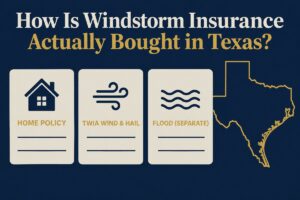
Nueces County is one of the 14 first-tier coastal counties, so windstorm is its own decision here. Many coastal property policies exclude wind and hail, and the coverage is bought back either from a private carrier or from the Texas Windstorm Insurance Association, created by the Legislature under Texas Insurance Code Chapter 2210 as the market of last resort for wind and hail only.
TWIA eligibility has rules that catch rental owners off guard. The property must be in one of the first-tier counties (or the eligible portion of Harris County), and the applicant must have been declined by at least one insurer actively writing wind and hail in those counties; a surplus lines company does not count as a declination. Property in a V flood zone that was constructed, altered, remodeled, or enlarged after September 1, 2009 must show proof of NFIP flood coverage. Construction on or after June 19, 2009 also runs into the building-code and windstorm-certification requirements in Section 2210.259 — the WPI-8 world.
If your rental is a duplex, fourplex, or small apartment building, note that TWIA writes commercial risks too, on its own forms with their own fair rental value provisions. Start with our windstorm insurance page and then ask for a TWIA coverage review.
Flood is always separate
No dwelling or homeowners policy in Texas covers rising water, storm surge, or surface water. That is a separate flood policy, through the National Flood Insurance Program or a private flood market. NFIP building limits depend on how the building is classified: a single-family rental follows the residential limit, other residential buildings carry a higher building limit, and non-residential and mixed-use buildings have their own structure. Contents coverage is a separate limit and only covers your property, not the tenant’s.
NFIP policies also carry a standard 30-day waiting period, with narrow exceptions — including a policy purchased in connection with a loan transaction, which is effective at the time of the loan. If you are closing on an investment property, that timing matters.
Liability, and why tenants should carry their own policy
Texas Property Code Chapter 92 puts duties on residential landlords: to repair conditions that materially affect the physical health or safety of an ordinary tenant after proper notice, and to install, inspect, and repair smoke alarms under Subchapter F. Those duties are the backdrop for most liability claims a rental owner sees, and they do not go away because you hired a property manager.
Your policy’s liability limit responds to claims against you. It does nothing for your tenant. A tenant’s furniture, electronics, and clothing are insured only under their own renters insurance in Corpus Christi — which is why a lease provision requiring renters insurance, with proof at move-in and at each renewal, is standard practice. Owners with several properties often add an umbrella policy over the underlying limits rather than raising each one.
When the rental becomes a business
One rental house is generally a personal-lines conversation. Several doors, short-term rentals, on-site employees, or a company that holds title starts to look like a commercial program, with the entity named on the policy and coverages that a dwelling form does not contemplate. Our business insurance page covers that side, and an independent agent can place either without steering you to one carrier.
Check this on your own policy
- Occupancy. Does the declarations page describe the property as a rental or as owner-occupied? A mismatch is a coverage problem waiting to happen.
- Named insured. If an LLC or a trust owns the property, is that entity on the policy — and is your property manager or lender listed where required?
- Dwelling limit. Is it based on today’s rebuild cost on the coast, or on what you paid?
- Roof settlement. Replacement cost or actual cash value? Is there a separate wind and hail deductible, and is it a percentage?
- Fair rental value. Is there a loss-of-rents limit, and for how many months?
- Wind and hail. Excluded on the main policy? If so, where is it — a private carrier or TWIA — and are the limits consistent with the dwelling limit?
- Flood. Do you have a policy at all, is the building classified correctly, and does the effective date line up with your closing?
- Liability. Is a liability limit actually shown, or did the policy come through as property-only?
- Lease. Does it require renters insurance and proof of it, and does it match what your policy assumes?
- Vacancy. What happens between tenants? Most forms restrict coverage once a building is vacant beyond a stated period.
Get a second set of eyes on it
Most rental owners on the coast are carrying three or four separate contracts — dwelling, wind, flood, liability — that were bought at different times from different sources and have never been read side by side. BenefitExcel will read them together, in writing, at no cost: request a free coverage review, and if you have an open loss, our claims help page is the place to start.
This article is general information for Texas property owners and is not a coverage opinion on any specific policy. What your policy covers depends on your property, your forms and endorsements, and your policy terms. Sources: Texas Department of Insurance (tdi.texas.gov), Texas Windstorm Insurance Association (twia.org), the National Flood Insurance Program (floodsmart.gov), and the Texas Property Code.
Not sure if you're overpaying?
It takes us less than five minutes to compare your current policy against 15+ Texas carriers.
Get a Free Quote