Small Business Insurance in Texas: What a Starter Program Looks Like
Small business insurance in Texas is not one policy you buy once — it is a program you assemble, and on the coast it has a few extra moving parts.
A “program” is four buckets, not one policy
Almost every small commercial program answers four questions: what happens if my stuff is damaged, what happens if I hurt someone or their property, what happens around vehicles, and what happens to my people. Everything else — cyber, professional liability, employment practices, umbrella — is a specialty layer bolted onto that frame once the frame exists.
The Texas Department of Insurance describes the common small-business starting point as a business owner’s policy (BOP): a package that combines property, liability, and business interruption coverage in one policy, tailored to small businesses.
Bucket 1: property — and the two perils it usually excludes
Commercial property insurance pays to repair or replace your building and business personal property after a covered event, and it can also pay some lost income while you cannot operate normally (TDI, commercial property insurance guide). Two details drive most coastal surprises.
First, valuation. Replacement cost pays to replace with property of like kind and quality up to the limit; actual cash value subtracts depreciation for wear and age. TDI’s own review requirements note that actual cash value settlement for roofs has been allowed where the cause of loss is limited to wind and hail.
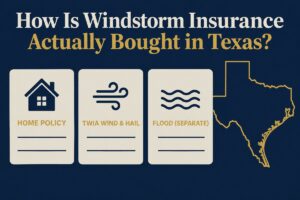
Second, windstorm and flood. Many coastal commercial property policies exclude wind and hail, which is why windstorm coverage is frequently written separately. The Texas Windstorm Insurance Association writes wind and hail only, in the 14 first-tier coastal counties — including Nueces, San Patricio, Aransas, Kleberg, Refugio and Calhoun — plus part of Harris County east of Highway 146. TWIA is a market of last resort: an applicant must have been declined by at least one authorized insurer actively writing wind and hail in the first tier, and the structure must be certified to building codes with limited exceptions. Flood itself is excluded on essentially every property form, so flood coverage is its own decision.
Business interruption deserves its own sentence: it generally responds to lost income after direct physical loss or damage from a covered peril. If the peril is excluded, the income loss follows the exclusion.
Bucket 2: liability — the certificate everyone asks for
General liability is the coverage your customers, landlords, and general contractors mean when they say “send me your COI.” It responds to bodily injury and property damage you cause to others.
In Texas, certificates of insurance are regulated. Insurance Code chapter 1811 and 28 TAC §§5.9370–5.9376 provide that a certificate cannot say something different from the policy it describes, that forms must be filed with and approved by TDI, and that a certificate may not be altered.
Bucket 3: vehicles — including the ones you don’t own
Texas minimum auto liability limits are 30/60/25: $30,000 per injured person, $60,000 per accident, and $25,000 for property damage. A commercial auto policy is the right home for owned trucks and vans; hired and non-owned auto coverage is the piece that addresses employees driving their own vehicles on company errands, which a personal policy may not cover in a business use.
Bucket 4: people — Texas work comp is optional, with strings
Texas is the outlier: private employers are not generally required to carry workers’ compensation insurance. A non-subscriber must notify the Division of Workers’ Compensation using DWC Form-005, filed annually between February 1 and April 30, and must report work-related injuries and illnesses involving more than one day of lost time, and any death.
Contracts add their own requirements. Labor Code §406.096 requires written certification of coverage for each employee on a governmental entity building or construction project, and 28 TAC §110.110 requires a posting at the project site. Sections 406.121–406.123 let a written agreement determine whether a subcontractor is treated as the general contractor’s employee, and allow a general contractor to agree in writing to provide coverage for a sub.
The specialty layers, and when each one starts to matter
- Professional liability — when clients pay you for advice, design, or a professional service, and a mistake would cost them money rather than break something.
- Cyber liability — when you hold customer data or payment information, or the business stops when systems do.
- Employment practices liability — once you have employees and the exposure becomes hiring, firing, and harassment allegations rather than slips and falls.
- Umbrella coverage — when contracts require limits above the underlying policies, which is common the moment you work for larger companies or public entities.
- Employee benefits — a separate track from property and casualty, and one that starts to matter for hiring long before most owners expect it.
One more market note: some coastal commercial risks are written by surplus lines insurers. Those insurers are not members of the Texas Property and Casualty Insurance Guaranty Association (Insurance Code ch. 462), so the safety net that backs an admitted carrier’s insolvency does not apply the same way.
Most owners in Corpus Christi start with a single quote for the building, or with the liability certificate a customer asked for, then discover later that the pieces do not line up: the property policy excludes the peril most likely to close the doors, the auto policy does not follow the employee running errands in her own truck, and the contract in the filing cabinet requires limits nobody bought.
Check these nine things on your own policies
- Is wind and hail excluded on your property policy? Look for the exclusion, then find the separate windstorm policy or TWIA declarations page that fills the gap.
- Is flood covered anywhere? If you cannot name the policy, you do not have it.
- Is your building and contents on replacement cost or actual cash value — and is the roof treated differently from the rest of the structure?
- Is business interruption on the policy, and for how long? Add up rent, payroll, utilities, and lease payments for a realistic rebuild window, not a week.
- What limits do your contracts actually require? Pull two or three customer or landlord agreements and compare the required limits to your declarations page.
- Does anyone drive for you in a personal vehicle? If yes, check for hired and non-owned auto.
- If you are a work comp non-subscriber, has DWC Form-005 been filed this year and is the required notice posted?
- Are your subcontractor agreements in writing, and do they say who carries coverage for the sub’s employees?
- Is any of your coverage written through surplus lines? Your policy will say so; ask what that means for your risk.
If you cannot answer four or more of those from your own declarations pages, that is not a failure — it is the normal state of a business that grew faster than its insurance file, and it is exactly what a review is for.
Where an independent agency fits
A captive agent can offer one company’s version of this program. An independent agency can compare several, and on the coast that matters more than usual, because the wind, flood, and property pieces often come from different markets and have to be assembled so the exclusions do not overlap into a gap. Our business insurance team in Corpus Christi does that assembly for local owners every week, and we can start from whatever you already have in the file.
If you want a second set of eyes on the four buckets, our free coverage review walks your existing declarations pages line by line, shows you where the gaps and overlaps are, and tells you plainly if what you have already works. No obligation, no pressure to move anything.
This article is general information for Texas business owners and is not a coverage opinion, legal advice, or a recommendation about any specific policy. What your policy covers depends on your property, your operations, and your policy terms. Primary sources: Texas Department of Insurance (tdi.texas.gov) — commercial property insurance guide, business interruption and other business insurance, insurance resources for businesses, certificates of insurance rules, and Division of Workers’ Compensation non-subscriber requirements; Texas Windstorm Insurance Association (twia.org) — coverage and eligibility; Texas Insurance Code chapters 462 and 1811; Texas Labor Code §§406.096 and 406.121–406.123; 28 TAC §§5.9370–5.9376 and §110.110.
Coverage protects the business; benefits keep the crew. If you are also weighing group health, dental or vision for your staff, see our page on employee benefits in Corpus Christi and our guide to group health insurance in Corpus Christi for small employers.
Not sure if you're overpaying?
It takes us less than five minutes to compare your current policy against 15+ Texas carriers.
Get a Free Quote